Your most expensive employee is a spreadsheet
Manual processes don't break. They compound. At 2× scale they cost a day a week; at 3× scale they cost a full-time role. Spreadsheet debt is real debt.

What this costs you: 5–15 hours per week. Compounding.
A client tracker built from three spreadsheets linked by VLOOKUP, maintained by someone who taught themselves Excel on YouTube in 2019. That's not a joke — it's load-bearing infrastructure in a $3M business.
These aren't bad decisions. They were good decisions at the time — fast, cheap, flexible. The problem is that they compound.
A manual process that takes 20 minutes today will still take 20 minutes next year. But if the business grows 30%, there are 30% more of them. And the person who built the spreadsheet is now spending their time maintaining it instead of doing the work they were hired to do.
That's spreadsheet debt — shortcuts that worked at one scale becoming liabilities at the next.
What it looks like at 2× and 3×
Say you're a 15-person professional services firm doing $3M. You've got a quoting spreadsheet that takes 25 minutes per quote, and you do 12 quotes a week. That's 5 hours — not trivial, but manageable.
Now you're at $5M. Headcount is 25. You're doing 20 quotes a week. Same spreadsheet, same 25 minutes each. That's 8.3 hours — an entire day of someone's week, doing work that hasn't changed in complexity at all. It just scaled.
At $8M, you're doing 30 quotes a week. That's 12.5 hours. You've now created a full-time role that consists entirely of maintaining a system built for a business half this size. And the person doing it is almost certainly not the person you'd choose to spend $70K a year on for data entry.
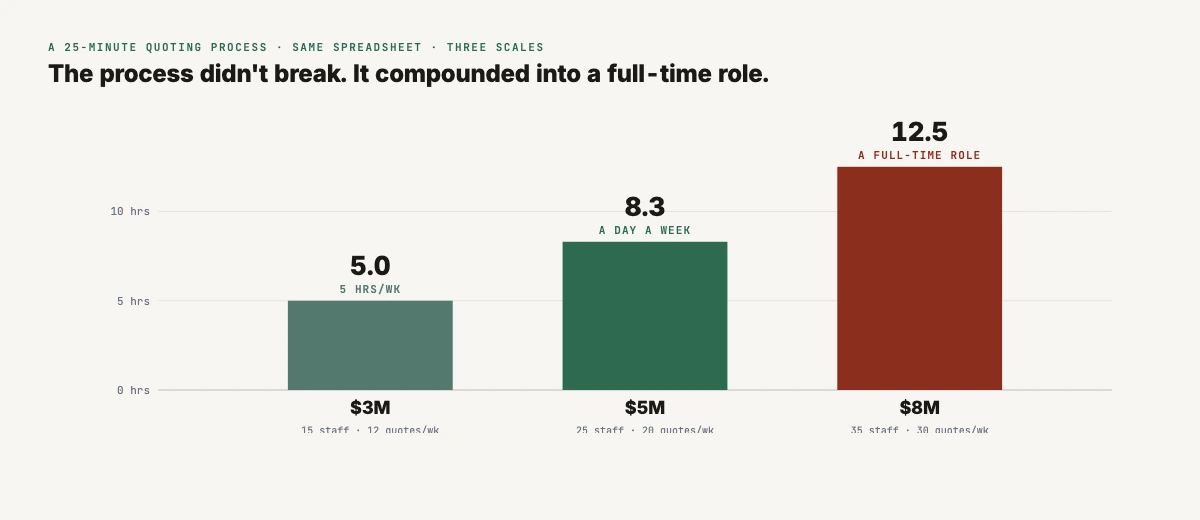
The spreadsheet didn't break. It just compounded until it became one of your most expensive employees.
How to find the ones that matter
Leaving the right spreadsheets alone is discipline, not neglect. Infrequent, low-stakes processes cost more to automate than they save.
Three questions sort the expensive ones from the rest:
How often does this happen? A process that runs daily at 20 minutes is 87 hours a year. Weekly is 17 hours. Monthly is negligible. Frequency is the multiplier.
Who's doing it? Twenty minutes of an admin's time is different from twenty minutes of a senior engineer's time. If your highest-paid people are doing work that exists because nobody built a proper system, the true cost isn't the time — it's the opportunity cost of what they're not doing instead.
What breaks when it goes wrong? Some spreadsheet errors are inconvenient. Others cascade. An invoicing error becomes a cash flow problem becomes a client relationship problem. A rostering mistake becomes an understaffed shift becomes a compliance issue. The fragility of the process is part of its cost.
Run through your operations with those three questions. Most businesses find 2–3 processes that are clearly costing more than they should, and 5–10 that are fine to leave alone. The ratio matters — fixing the wrong ones wastes effort.
Most spreadsheet debt is plumbing, not intelligence. The data needs to move between systems without a human copying it across — integration work, not artificial intelligence.
The point is finding the processes that are quietly compounding and making a deliberate decision about each one: fix it, simplify it, or leave it alone. Debt you can see, you can manage. Debt you can't see compounds until it shows up as a crisis.
Karl Howard · Reforged · 14 April 2026
If any of that sounds familiar — if the puddle is getting bigger, the spreadsheets are compounding, or the documents know things nobody's written down — start a conversation.